9 Best Social Media Scheduling APIs for Developers (2026)

Updated · 12 min read

On this page
- Social media scheduling APIs compared
- 1. PostPeer
- 2. SchedPilot
- 3. Ayrshare
- 4. Zernio (formerly Late)
- 5. Postiz
- 6. Blotato
- 7. Upload-Post
- 8. Buffer
- 9. Hootsuite
- Zapier and Make as an API substitute
- How to schedule social media posts with an API
- Which social media scheduler has a public API and webhooks?
- Embedding scheduling in your own product
- Picking one
- Frequently asked questions
TL;DR
- PostPeer: best for posting plus comments and DMs through one integration.
- SchedPilot: best for products where AI agents post and a human approves first.
- Ayrshare: best for high-volume, multi-tenant SaaS.
- Zernio: best if you also want inbox, analytics and ads behind one key.
- Postiz: best when tokens can’t leave your own servers.
- Blotato: best for pipelines that generate AI images and video.
- Upload-Post: best for publishing and nothing else.
- Buffer: cheapest way to script posts to your own channels.
- Hootsuite: only for enterprise teams already on it.
The best social media scheduling API depends on what sits on top of it. For posting plus comments and DMs, PostPeer. For a product where AI agents write posts and a person approves them, SchedPilot (which I build), because it pairs a REST API with a hosted MCP server, OAuth2 and an approval calendar. Ayrshare fits high-volume pipelines, Zernio fits teams that want a whole social backend, and Postiz is the one to self-host.
Why pay for a scheduling API at all? Because direct integrations are miserable. Meta’s app review for Instagram publishing takes weeks and gets rejected for vague reasons. X charges for write access. TikTok’s Content Posting API needs an audit before your posts leave “private” visibility. LinkedIn tokens expire every 60 days. A developer at a 3-person startup I talked to spent six weeks on Instagram approval alone.
One aggregator API replaces all of that with a single bearer token. If you only want the how-to, jump to how to schedule social media posts with an API.
Social media scheduling APIs compared
A dash means the provider doesn’t state it publicly or I haven’t confirmed it.
| API | Networks | Webhooks | MCP server | Approval step | Pricing model | Free way to test |
|---|---|---|---|---|---|---|
| PostPeer | 10, including Google Business Profile | Yes, post status | Yes, hosted | – | – | Playground in the dashboard |
| SchedPilot | 10, including Reddit | Yes | Yes, hosted | Yes, approval calendar | Flat, $29 to $99 a month for 5 to 100 accounts | 7-day trial |
| Ayrshare | Broad | Yes, post status | Yes | No | Per profile | – |
| Zernio | 15, including Reddit and WhatsApp | Yes, per platform | Yes, hosted | – | Per account: $6, then $3, then $1, plus X API costs | First 2 accounts free |
| Postiz | 34, per its docs | Yes | Yes | – | Free, self-hosted (AGPL) | Free |
| Blotato | 9 | – | Yes, hosted | No | Flat, from $29 for 20 accounts | No, API excluded from trial |
| Upload-Post | Wide | – | – | No | – | Free tier |
| Buffer | The majors plus Mastodon and Bluesky | – | Yes | – | Per channel, API limits by plan | Free plan, 1 API key |
| Hootsuite | – | – | Yes, four servers | Yes, in the app | Partner program | No |
1. PostPeer
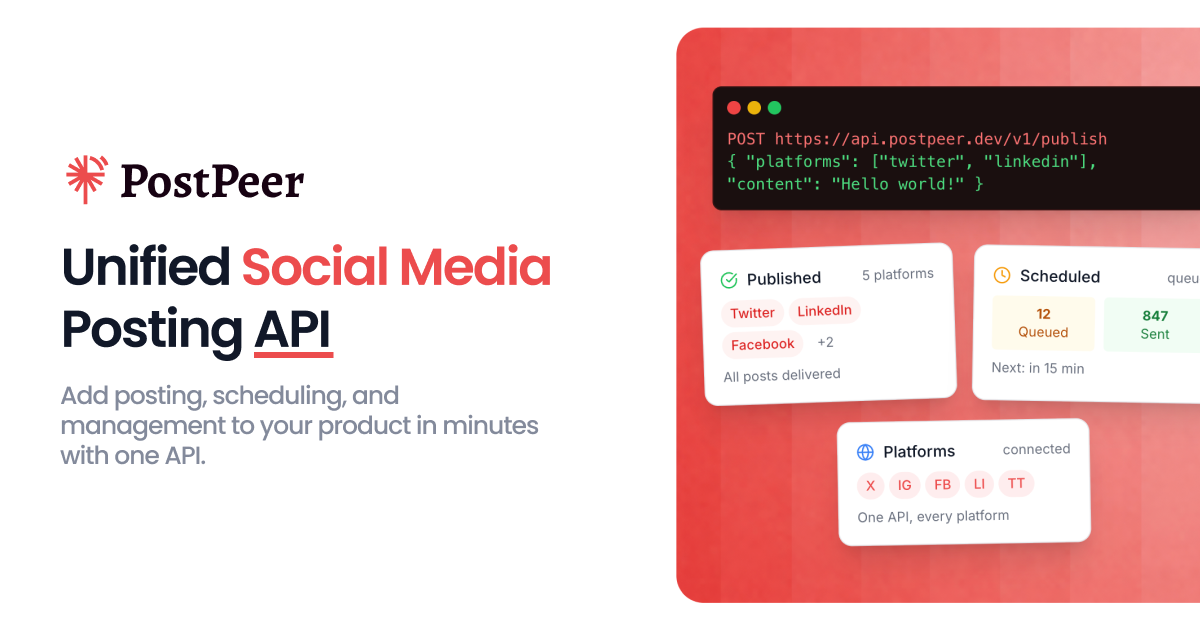
PostPeer is a unified social media API for scheduling and publishing across X, Instagram, Facebook, LinkedIn, TikTok, YouTube, Threads, Pinterest, Bluesky and Google Business Profile, with time zone scheduling built in.
Best for: apps that need more than a posting queue. The same integration covers analytics, comments and messaging where each platform supports them, and Instagram supports all three. PostPeer recently added comment automation rules with keyword matching, public replies and a DM action.
You connect accounts in the dashboard, test a post in the Playground, and edit or cancel posts after you create them. Webhooks report post status. There’s a hosted MCP server for agents, and it works with n8n.
Downside: pricing isn’t something I could pin down from its public pages, and there’s no approval step that I know of. Verdict: the strongest pick when your product needs to answer comments, not only publish.
2. SchedPilot

SchedPilot is API-first and MCP-first. The REST API covers accounts, posts, media upload, deletion and analytics, and the same operations are exposed through a hosted MCP server. So Claude, ChatGPT, Cursor or any MCP client can schedule posts in plain language without glue code. There’s also a CLI, webhooks and custom n8n nodes.
Best for: products where your users connect their own accounts and an AI agent does the posting. OAuth2 means your users connect once and you publish everywhere without maintaining per-network integrations. Every post an agent or API call creates can wait in a calendar for human approval. If I were shipping an autonomous posting agent, that’s the feature I’d pick it for. (I ranked the schedulers that work with Claude, ChatGPT and AI agents separately.)
Ten networks: X, LinkedIn, Instagram, TikTok, Threads, Facebook, Pinterest, Bluesky, YouTube and Reddit. X threads are a native replies array. Agencies get client workspaces with the API on every plan.
Pricing: API access is included on every plan, from $29 a month for 5 accounts ($21 billed yearly) up to $99 for 100 ($79 billed yearly). There’s a 7-day trial.
Biggest downside: scale. It’s a small team, and enterprise features like SSO aren’t there. Verdict: the best fit when agents write and humans approve, and flat pricing keeps it affordable for small teams.
3. Ayrshare
Ayrshare has been the default “social media API” answer for years, and the docs show it. Broad network coverage, webhooks for post status, and a Business plan that creates an isolated profile per end user, which is exactly what a multi-tenant SaaS needs. It recently added an MCP server too.
Best for: high-volume pipelines with no human in the loop.
Downsides: pricing scales per profile, which gets expensive once your app has a few hundred users. And there’s no approval workflow. If a bug schedules 400 posts, they go out. Verdict: the safe, mature choice. Model the per-profile cost at your real user count before you commit.
4. Zernio (formerly Late)
Zernio is the API that used to be called Late (getlate.dev), and it’s grown a lot since the rename. One REST API covers 15 platforms, including X, Instagram, Facebook, LinkedIn, TikTok, YouTube, Threads, Pinterest, Bluesky, Reddit, Google Business Profile and WhatsApp.
Best for: teams that want a full social backend. The same key gets you a unified comments and DMs API, analytics and an ads API. There’s a hosted MCP server, official SDKs for Node, Python, Go, Ruby and Java, and a drop-in package for anyone moving off Ayrshare’s SDK. Its webhooks are the most detailed I’ve seen, with separate events for published on one platform, failed on one platform, published everywhere, or only partly published.
Pricing is per connected account with every feature included. The first two accounts are free with unlimited posts, then $6 per account up to 10, $3 up to 100 and $1 beyond that. X API calls are billed on top at X’s own rates, so set a spending cap if X is a big share of your volume.
Downside: per-account pricing is cheap for a product posting to its own handful of accounts and heavier for a SaaS where every customer connects several. Verdict: the most complete backend here.
5. Postiz
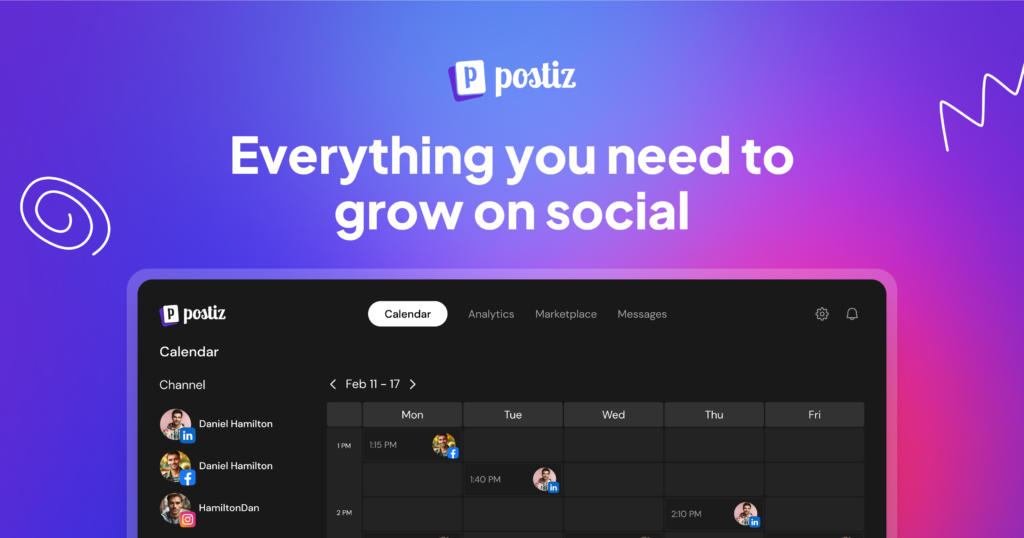
Postiz is open source under AGPL and self-hostable, with a public API, webhooks, an MCP server and a CLI. Its docs list 34 platforms, more than any hosted API here.
Best for: teams whose compliance people won’t let customer tokens leave the building. Setup is one Docker Compose command that starts the app with Postgres, Redis and Temporal. There’s a community Helm chart for Kubernetes, and Coolify can run the same Compose file.
The catch is real. You create your own developer app on each network and paste the keys in, so all the platform approvals I complained about above become your job again. When Instagram changes an endpoint, you upgrade the container. Analytics are thinner than the hosted options. Verdict: free in dollars, not in hours.
6. Blotato

Blotato is a hosted API and MCP server across nine networks, with unlimited AI text generation and image and video generation on credits. Flat pricing from $29 with 20 accounts, API included on the entry plan.
Best for: pipelines where AI media generation is part of the job. Downside: the API is excluded from the trial, so you pay before testing it, and there’s no approval step.
7. Upload-Post

A pure posting API with a free tier and a longer network list than most. No dashboard, no AI, no approvals. Best for developers who want the publishing layer and nothing else. Cheap and narrow, which is sometimes exactly right.
8. Buffer
Buffer’s API was closed to new developers for years, and a lot of articles still say so. That’s out of date. Buffer now includes API keys on every plan: 1 key and 1,000 requests per channel a month on Free, 3 keys and 3,000 requests on Essentials, 5 keys and 10,000 on Team. It runs an MCP server too.
Best for: posting to your own channels programmatically if you already use Buffer. Downside: the limits are built around one team’s channels, with no OAuth flow for your users, so it’s the wrong base for a multi-tenant product. If you’re leaving Buffer for API reasons, I compared Buffer and Hootsuite alternatives with a proper API.
9. Hootsuite

Hootsuite’s API sits behind a partner program aimed at enterprise integrations, so access starts with a sales conversation and a review. Once in, you get the deepest approval and team features on this list. It also ships official MCP servers now, but those need an active Hootsuite plan.
Fine for a bank building an internal tool. Wrong for a startup that needs a key today.
Zapier and Make as an API substitute
Not an API, but worth naming. Publer, SocialBee and Metricool expose Zapier and Make actions, and many small teams use those instead of a real integration. It works until you need retries, media over a few MB, per-network fields, or more than a couple thousand tasks a month. At that point the task bill is bigger than a scheduler subscription. My roundup of social media automation tools for n8n, Make and Zapier covers which ones have the best native actions.
How to schedule social media posts with an API
You need an aggregator that sits between your code and the networks. You connect your social accounts to it once, and from then on your app, your n8n workflow or your AI agent creates posts with one request. The flow is nearly identical on every API above, so switching providers later is an afternoon of renaming fields.
- Get a key. Create an API key in the provider’s dashboard and send it as a bearer token. Keep it on your server. A key in front-end JavaScript gets scraped within days.
- Connect the social accounts. For your own profiles, do this once in the dashboard. For your users’ profiles, send them through the provider’s OAuth flow. Either way you end up with an account ID per profile.
- Upload media first. Most APIs want a public media URL or an upload call that returns a media ID. Most failed posts start here, because TikTok and Reels reject video with the wrong aspect ratio or length.
- Create the post. One POST with the text, the account IDs, the media and a publish time.
- Check what happened. A 200 on create means queued, not published. Subscribe to a webhook, or poll the post status, and alert someone on failure.
Here’s the shape of step four. Field names differ between providers. The structure doesn’t.
curl -X POST https://api.example.com/v1/posts \
  -H "Authorization: Bearer YOUR_API_KEY" \
  -H "Content-Type: application/json" \
  -d '{
    "accounts": ["ig_123", "li_456", "tt_789"],
    "text": "Launch day.",
    "media": ["https://cdn.example.com/launch.mp4"],
    "scheduled_at": "2026-10-14T13:00:00Z"
  }'
That one request puts the same post on Instagram, LinkedIn and TikTok at the same moment. Add a Facebook account ID and it goes there too.
Three things bite people in production. Send the publish time in UTC and convert in your own code: 9 am in New York is 13:00Z in summer and 14:00Z in winter, and a scheduler that forgets this is an hour off for half the year. Store the post ID before you retry anything, or use an idempotency key if the provider has one, because a blind retry publishes twice. And validate per network before you send. Instagram refuses a post with no image or video, and X cuts a long caption that LinkedIn accepts happily.

Which social media scheduler has a public API and webhooks?
SchedPilot, PostPeer, Ayrshare, Zernio and Postiz all have both. Webhooks are the part people forget to check until something fails quietly. Without them, you schedule a post for 9 am, the API says 200, and you find out on Thursday that Instagram rejected the video.
Zernio’s are the most granular, including a “partial” event for a post that went out on LinkedIn but failed on TikTok. Design for that case. A cross-platform post is really four or five separate posts, and they don’t all succeed together. Whichever provider you use, verify the signature, return 200 fast and do the real work in a background job, and make your handler safe to run twice, because providers retry when your server is slow.
Embedding scheduling in your own product
A lot of people reading this want something like Hootsuite as an API inside their own app. Hootsuite itself is the wrong place to look, since its API is partner-gated.
You need three things: an account connection flow your users complete under your brand, each customer’s accounts isolated from everyone else’s, and pricing that still works at 500 customers. SchedPilot covers the first two with OAuth2. Ayrshare does it with per-user profiles on its Business plan, where the per-profile cost is the thing to model. Postiz gets there through self-hosting, with the maintenance that comes with it.
WhatsApp is the odd one out if it’s on your wishlist. It’s messaging through Meta’s WhatsApp Business Platform, not a feed you publish to, so plan for a second integration. If MCP is the part you care about, my list of social media tools with MCP servers goes tool by tool.
Picking one
Building a product where users connect their own accounts and AI does the posting: SchedPilot, because OAuth2 plus MCP plus an approval calendar is a combination I haven’t seen elsewhere. Comments and DMs alongside publishing: PostPeer or Zernio. High-volume internal pipeline with no humans in the loop: Ayrshare. Self-hosting is mandatory: Postiz.
And if you’re still weighing direct integrations against an aggregator, do the math on engineer-hours first. Six weeks of one developer’s time buys a very long subscription. For the dashboard-first picture, see the best social media scheduling tools.
Disclosure: I build SchedPilot. Every API here is compared on the same criteria, and SchedPilot’s limits are listed next to its strengths.
Frequently asked questions
What is the best social media scheduling API?
It depends on the job. PostPeer if you need comments and DMs alongside posting. SchedPilot if AI agents do the posting and you want an approval step, with the API on every plan from $29 to $99 a month. Ayrshare for a high-volume pipeline with no human approval, Zernio for posting, inbox and ads through one key, and Postiz if tokens can’t leave your own servers.
What is the best API-enabled scheduling software?
For a dashboard and an API in one product, SchedPilot, because the API, MCP server and approval calendar come with every plan. Buffer also gives API keys on every plan, but its limits are built around one team’s channels. Pure APIs like Ayrshare and Zernio are better if you don’t need a dashboard at all.
Which scheduler supports webhooks when a post is published?
SchedPilot, PostPeer, Ayrshare, Zernio and Postiz. Zernio goes furthest, with separate events for published on one platform, failed on one platform, published everywhere and only partly published. Subscribe to failure events too, or you’ll never hear about the video Instagram rejected.
What is the best open source social media scheduler with a REST API?
Postiz. It’s AGPL, self-hosts with one Docker Compose command, and comes with a public API, webhooks, an MCP server and 34 platforms. You register your own developer app on every network and upgrade the container when a platform changes its API.
What API supports flexible scheduling for global users?
Any of the hosted APIs here, as long as you handle time zones properly. SchedPilot and PostPeer both let you schedule in a specific time zone. Store each user’s time zone, convert to UTC in your own code and send UTC, so daylight saving doesn’t shift posts by an hour.
What are the best Zernio alternatives for social media scheduling?
SchedPilot if per-account pricing is the problem, since it’s a flat $29 to $99 a month for 5 to 100 accounts and adds an approval calendar. PostPeer is the closest match for posting plus comments and DMs. Ayrshare suits multi-tenant SaaS, and Postiz is the self-hosted answer. You give up Zernio’s ads API and its detailed per-platform webhooks.

Written by Andrei Saioc
Andrei Saioc is a software founder who builds SchedPilot, a social media scheduler with an MCP server and API. He tests scheduling tools, AI agents and posting times for a living and writes about what actually works.
More about me →